

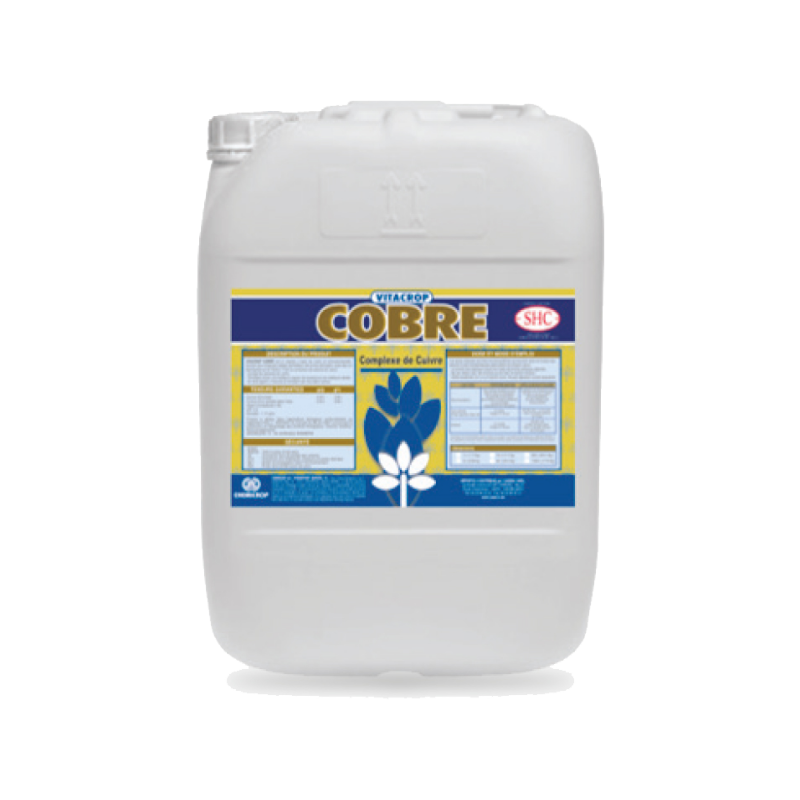
Description
Product Description:
- EC FERTILIZER – COPPER SULPHATE-BASED FERTILIZER SOLUTION.
VITACROP COBRE is a corrector of copper deficiencies based on copper sequestered by carboxylic groups of organic acids that applied at low doses give the product several remarkable features:
- Fast absorption and penetration of copper in the plant.
- High systemic capacity, both ascending and descending, so it can be applied either by irrigation or foliar.
- Low copper dose (less waste).
- Lower risk of resistance.
- Increase the vegetative activity of the plant.
- Correct possible copper deficiencies.
- Involved in natural processes of formation of self-defense substance of the plant.
- VITACROP COBRE acts on fruit improving its uniformity, color, brightness, sugar formation, and postharvest resistance.
Product Benefits:
- Copper has two roles: a physiological role, and a role in preventing fungal diseases.
Physiological Roles:
- Play a role in the formation of some enzymes that play an important role in oxidation-reduction reactions in the plant.
- Copper is an essential element for the formation of chlorophyll in plants, so it has an important role in the photosynthesis process.
- It increases the plant’s carbohydrate content.
- It is found in a large proportion of the roots of the plant, so it has an important role in the metabolism process in the plant.
- It acts as a catalyst for plant respiration.
- Promotes flowering and fruit ripening.
- Limits the toxicity of trace elements such as zinc and manganese.
- Copper is included in the formation of tyrosinase enzyme, which is the enzyme responsible for colouring the pulp of potato tubers in a dark colour in the presence of oxygen.
- It is included in the formation of the enzyme Ascorbic acid oxidase, which is responsible for the oxidation of ascorbic acid.
- It plays a role in the interaction of nitrogen inside the plant, as it has a major role in the formation of protein, therefore (the ability to absorb copper increases in the presence of amino acids and ammonium).
Copper in Resisting Fungal Diseases:
- Copper increases the formation of lignin and wood vessels, which increases the plant’s defensive ability.
- The divalent copper ion Cu++ is released and absorbed by the fungus spores until it reaches the lethal dose concentration level. The copper ion destroys the protoplasm in the fungi cell and destroys it.
- It is used to increase plant resistance to fungal diseases such as downy mildew, root rot and navel rot in citrus fruits.
Composition:
- Copper (Cu) water-soluble 5.5%
- Sulfur (S) 2.8%
Physical Characteristics:
- pH: 3.5
- Density: 1.17 g/cc
Dosage and Application Method:
The indicated dosages are recommendations that could change according to the needs and characteristics of each crop.
- The product will be applied following the codes of good farming.
- Do not mix with products that cause alkaline.
- Use only in case of recognized Do not exceed the appropriate doses.
- Don’t use it at the flowering stage.
- Not recommended to use it with products containing phosphor as that will create substances insoluble in water such as copper sulfate that could lead to blockage in the irrigation system.
| CROP | FERTIGATION | FOLIAR APPLICATION |
| Recommendations | In crops sensitive to copper (stone fruit trees, vineyards and horticultural in certain conditions) it recommended the application exclusively by Fertigation | Apply alone, without mixing with other products in the early hours of the morning or evening, out of the hours of maximum solar radiation. |
| General dosage (Fruit trees, citrus, olive trees) | 0.5 -1.5 L/acre Every 10-15 days | 1.5 – 3 cc/L. -(0.5 -1.5 L/acre) With a minimum interval of 15 days. |
| Horticultural | 0.5 -1.5 L/acre Every 10-15 days | 1.5 – 3 cc/L (at 4 cc/L can burn) With a minimum interval of 12-15 days. |
| Spinach and lettuce | 1.5 – 2 L/acre Every 10 – 15 days | Maximum 2 cc/L and solution of 500 L/acre with a minimum interval of 12 – 15 days. |
Packing:
- 1 L – 5 L – 10 L – 20 L – 220 L – 1000 L.